
Article 4 Restrictions on HMOs Coming to Darlington!!!
This article explains the upcoming Article 4 Direction affecting HMO permitted development rights in Darlington, what the new controls mean for conversions after July 2026, and how property investors and developers can plan ahead.
This article will be useful to you if you own, are buying, or are considering converting property to HMOs in Darlington.
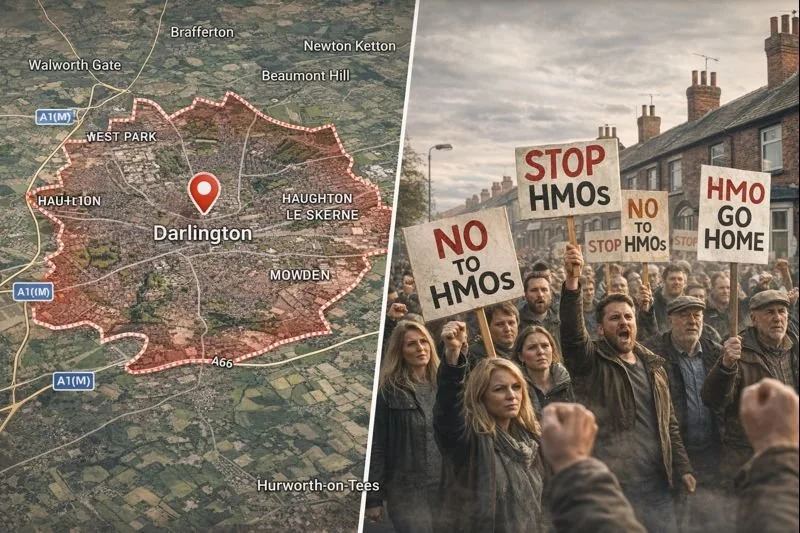
Darlington Borough Council has confirmed that an Article 4 Direction covering HMOs will come into force on 28 July 2026.
What is an Article 4 Direction?
An Article 4 Direction is a planning control used by councils to remove automatic development rights.
You may already be familiar with Article 4 Directions in conservation areas, where they restrict things like changing windows, doors, roofs, or façades. The principle is the same here.
In Darlington, the Article 4 Direction is being used specifically to control the conversion of houses into HMOs.
At present, many small HMOs can be created under permitted development, meaning no planning application is required.
Once the Article 4 is in force:
That automatic right is removed
Converting a house into a small HMO (up to 6 people) will require full planning permission
Applications can be assessed against local policy, objected to, delayed, or refused
Article 4s don’t ban HMOs outright, but they introduce control, discretion, and risk where there was previously certainty.
What does this mean in practice?
Up until 28 July 2026, a change of use from a dwelling (C3) to a small HMO (C4) can still be carried out under permitted development, provided it is lawfully commenced beforehand.
After that date:
HMO conversions will no longer be permitted development
Full planning permission will be required
Certificates of Lawfulness will not apply unless works have already started
In short: the window is closing.
A note on what we’ve seen elsewhere
We’ve seen similar Article 4 Directions introduced in other councils across the UK.
Typically, this creates a transition period where:
There is a short-term surge in HMO delivery before the deadline
Room supply increases
Rental growth softens or adjusts as the market absorbs that stock
During this phase, the investors who struggle tend to be those who are over-leveraged or relying on optimistic rent and valuation assumptions.
Those who come through strongest are the ones who:
Bought well
Controlled refurbishment costs
Didn’t over-stretch on commercial valuations
Took a long-term view
This is less about panic and more about getting the numbers right.
Existing HMOs & lawful use
For existing HMOs, particularly smaller or unlicensed ones, there may be a need to:
Confirm lawful existing use
Apply for a Certificate of Lawful Existing Use where appropriate
This is especially relevant where properties have been operating as HMOs for many years but were never formally regularised.
How we can help
At 81 North Architecture, we regularly support investors with:
HMO feasibility and strategy advice
Certificates of Lawfulness (existing and proposed use)
Planning applications where required
Design, Building Regulations, and construction-ready drawings
Sensible coordination with planners, consultants, and contractors
Whether you’re:
Sitting on a property you might convert
Mid-purchase and reassessing your numbers
Or reviewing an existing HMO portfolio
We can help you navigate this period calmly, strategically, and safely, not just in Darlington either… We’ve helped with HMO schemes as far as Manchester to the west, and Scarborough to the east.
If you’d like a quick conversation about how this affects your property or pipeline, just reply to this email or drop us a message.
Better to plan now than be forced to react later.
Best regards,
Anthony Boyce
81 North Architecture
Frequently Asked Questions: HMOs, Conversions & Article 4 Directions
What is an HMO?
An HMO (House in Multiple Occupation) is a property rented by three or more people who are not from the same household and who share facilities such as a kitchen or bathroom. HMOs are subject to specific planning and licensing controls depending on size and location.
What is an HMO conversion?
An HMO conversion is the process of changing a single dwelling into a property occupied by multiple unrelated individuals. This can involve internal reconfiguration, fire and acoustic upgrades, and in many cases, planning permission or permitted development assessments.
Do I need planning permission to convert a house into an HMO?
It depends on the size of the HMO and the location. Small HMOs (up to 6 occupants) may be created under permitted development in some areas, unless an Article 4 Direction removes those rights. Larger HMOs (7+ occupants) always require full planning permission.
What is an Article 4 Direction and how does it affect HMOs?
An Article 4 Direction removes permitted development rights. In areas covered by Article 4, even small HMO conversions require full planning permission, allowing councils to assess impact on housing mix, parking, and amenity before approving or refusing proposals.
Does Article 4 mean HMOs are banned?
No. Article 4 Directions do not ban HMOs. They remove automatic rights and require proposals to be assessed through the planning process. Well-designed HMOs with strong planning justification can still be approved.
Can I convert a property to an HMO before an Article 4 comes into force?
In many cases, yes. If permitted development rights still apply before the Article 4 implementation date, a lawful conversion may be possible. Timing, evidence of use, and compliance are critical, so early professional advice is strongly recommended.
What happens to existing HMOs after Article 4 is introduced?
Existing lawful HMOs can continue to operate. However, owners are often advised to secure a Certificate of Lawful Existing Use to formally confirm the status of the property before new restrictions take effect.
What are the biggest planning risks with HMO conversions?
Common risks include:
Article 4 restrictions
Over-concentration policies
Parking and refuse requirements
Noise and amenity concerns
Inadequate internal layouts
Many of these risks can be reduced through early feasibility and planning strategy.
Do HMO conversions need building regulations approval?
Yes. All HMO conversions require compliance with building regulations, including fire safety, sound insulation, ventilation, and means of escape, regardless of whether planning permission is required.
Why should I use a specialist for HMO conversions?
HMO conversions sit at the intersection of planning, building regulations, licensing, and investment viability. A specialist can identify risks early, avoid costly redesigns, and help ensure the scheme is both compliant and commercially viable.
When should I get advice on an HMO project?
Ideally before making an offer on a property. Early advice can identify planning constraints, Article 4 risks, and feasibility issues that may affect value, funding, or long-term operation.
Can 81 North Architecture help with my HMO conversion, regardless of size or occupier type?
Yes. 81 North Architecture has extensive experience designing and delivering HMO conversions of varying scales, from smaller 3–6 person HMOs through to large multi-unit schemes of up to 29 occupants.
We have worked across a wide range of HMO typologies, including standard professional and white-collar accommodation, executive lets, and specialist schemes such as assisted and supported living. This breadth of experience allows us to tailor layouts, fire strategies, amenity provision, and planning approaches to suit both the occupiers and the regulatory environment.
By understanding how different tenant types actually use a building, we are able to design HMOs that perform better operationally, meet licensing and planning requirements, and remain commercially viable long term.
Our experience across multiple occupier types means design decisions are informed not just by regulations, but by how HMOs are managed, occupied, and operated in reality.
